17 September 2010

jobs?

Per chance the odd reader of this humble blog is looking to recruit any gleaming & promising part II assistants in london - I'm your man! Seeing as I'm done with the dissertation and only working on a few digital/video projects that are about to end, I'm looking for a job.

So... In case you're doubtful of my many, many talents, check out ben.si/architecture, where I'm sure you'll see I can handle basically anything that is handed my way.

And then, at a leisurely pace, no rush, if you will... hire me!
:)

6 September 2010

Crux of the Fold

edit: This post has since been expanded into its very own blog - visit Crux of the fold, the blog


Yay, I have finished my architectural dissertation. And it is called (drum roll, please) Crux of the Fold. It is basically all about what architecture is becoming, what is bringing this change about, and some other things as well.. In other words:


In this dissertation we are going to explore the identity of contemporary architecture. As most everything regarding architecture is beginning to be conducted in a virtual digital environment, the result is more than a change of tools, but a different architecture altogether. This is to be done through a series of observations focusing on key aspects of emerging architecture’s many facets.

To appropriately explore the character of this new architecture, the nature of virtual is explored, as is the identity of digital. The aim is to discover what this architecture is all about and where the current stream of exploration is leading. And most importantly, what is on the other side of cutting edge.


And in its entirety:
Benjamin Rancic: Crux of the Fold
London Metropolitan University: MA Architecture History, Theory and Interpretation - Final Thesis


4 August 2010

bridges

i'm a great fan of occasionally burning bridges, its great fun. the problem is that they tend to stay burnt. regardless, there is a bunch of bridges that caught my eye for various reasons...

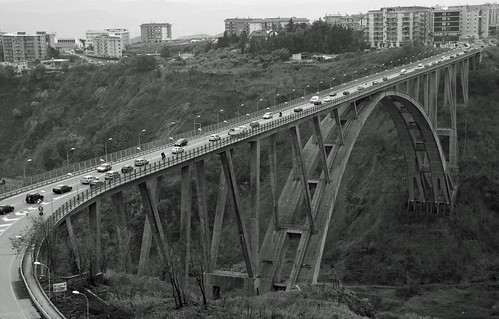
I was trying to find Musmeci's bridge in Potenza:


its a lovely design, much unlike traditional bridges. whereas the shape of a regular bridge (more or less loosely) approaches an ideal distribution through the use of simplified geometry, this one is a tour de force in catenaries. through the use of double-curved surfaces it support the road more like caterpillar than a pillar. and that is to say nothing of its aesthetics or uniqueness.

it is covered further on this blog dedicated to concrete


anyways, along the way i stumbled on another couple of things as well.. an impressive bridge a well, however much more geometrized:
this is what a regular bridge is like (obviously, i hear you say). anyways, the supporting curve works in much the same way as the one in Potenza, however considerably dematerialized and abstracted. the catenarily curved surfaces are here reduced to one main arch, supported by point supports spread along the length of the road. what rescues this particular bridge form banality is the split and/or tilted supports - notice how they're not vertical and how they join in together.


but returning to canteraies, a more recent example is the puente cascara by west 8 in Madrid:
 the support and supported (or object and subject, as it were) are flipped around in this case. as the usable surface is hung from the support rather than leaning onto it, the support begins to act as a dome. a considerably elongated dome, but still. the forces within the supports are those of compression in either case, with the load coming from under as opposed to above - and the pedestrians get a roof, yay!
and more pictures on this other blog.


but when mentally meandering around bridges, trnovo bridge in ljubljana by plecnik is worth mentioning as well:
other than its sculptural additions, rustic treatment and a very echoy underside, its party trick are trees. some 8 birches grace the bridge as a contiuation of a treelined street that leads up to it. apparently it is one of the oldest tree-populated bridges in the world


but then again, what's all the fuss about birdges, anyway?

23 July 2010

typologization of non-places

Dissertation WIP [= Work In Progress ya'll!]


[...]

The first type of these built undifferentiated entities are generic spaces, which function as a beacon of anonymity in an otherwise fully diversified world. It is spearheaded by petrol stations and characterized by generic spaces which are inserted into populated places. By creating a series of identical and instantly recognizable spaces, the experience of inhabiting one is made to be as similar as possible to inhabiting another. This is achieved by utilizing identical floor plans, equipment, uniforms and serving identical products within a standardized environment of fixed temperature and musical/vocal background. Although generally small in terms of architectural size, they are nothing if not compact.

The second are non-places. They achieve a curious trick, where through creating a unique object for a specific place, they create an fundamentally anonymous environment. Whereas they are there, they might as well be anywhere else. The champion of this phenomenon is the international airport, but examples such as shopping malls, parking garages or large medical institutions could be used in its place. Through its own vastness creates a world in itself, frequently with the spatial qualities of a Moebius strip. Limited, but never ending. Unique, yet self-similar. Bland, because of being too spicy. With the most important element being the “You are here” sign, presented in an appropriate language, along with a sufficiently large arrow pointing at itself. The architectural qualities of such spaces can also be described as Big in Koolhaasian terms, where even if they choose a style or concept, it becomes overwhelmed by it’s own Bigness. There is no definite style for Bigness, and yet they are unmistakable, not least through their bigness.

The third step of this un-place evolutionary scale are conceptual places. Although firmly rooted into a specific place, they are there only in passing. By folding the Cartesian grid from the proto-example around the user, they become inhabitable manifestations of abstract terms such as geometry, body, nation, etc. The pure-bred example is the Expo pavilion - an encapsulated cultural embassy, without the paperwork or border controls. It is essentially a displaced slice of land or an idea given corporeal form, striving to instantly consume the visitor and conjure up an immersive virtual world.

The fourth and final step is the wholly virtual spaces. By achieving material disconnectedness that is only aspired to (intentionally or otherwise) in previous types, it offers a truly endless plateau of digital virtuality. By shaping this endless incorporeal, yet malleable space according to our needs, an inhabitable virtual space is created. The current proliferation of blogs/personal pages can be likened to the past population of the Wild West, bar the natives. Every participant can potentially establish a virtual outpost in a seemingly endless space.

[...]

16 July 2010

Drops

New short film released - Drops:


Fashion by Nika Urbas,
photography by Matjaz Tancic,
production by ben.si


PS: mind the HD option (!)